

Marketing & bán hàng
- Bài viết
- 8
- Framework
- 31
- Đọc hết lộ trình
- 65phút
- Cập nhật

Đọc theo thứ tự
Các bài của chủ đề này xếp theo thứ tự nên đọc. Đọc lần lượt thì mỗi bài dùng lại khung của bài trước.
Bắt đầu từ bước 1- Bước 1
STP khi vào thị trường mới: chọn khách trước, định vị sau
Cầm 60 triệu đồng marketing mở tỉnh mới trong 3 tháng, chọn nhầm tệp khách có payback 7,7 tháng thay vì 1,9 tháng sẽ làm cạn vốn trước khi có đơn lặp lại. Cách làm STP gọn: tính CAC và sức chở đội ngũ để chốt khách trước, rồi gắn định vị vào cam kết kiểm chứng ngay.
Đọc bài - Bước 2
Năm chiến lược định giá: bảng chọn cho lần ra mắt của SME
Lấy chi phí biến đổi 120.000 đồng cộng 30% ra giá bán 156.000 đồng buộc xưởng phải đẩy 1.667 bộ mới hoà vốn khuôn 60 triệu, dù khách mục tiêu sẵn sàng trả 220.000 đồng. Đặt năm chiến lược định giá của Kotler lên cùng một bảng tính hoà vốn giúp SME chốt giá mở bán sát dòng tiền.
- Bước 3
Doanh thu định kỳ và bài toán khách rời bỏ
Chuyển từ bán đứt sang gói thuê bao tháng sẽ kẹt cứng quy mô nếu tỷ lệ khách rời bỏ (churn rate) ngang bằng tốc độ kiếm khách mới. Công thức tính trần thuê bao, ngưỡng hoà vốn CAC cùng dữ liệu Dish Network, Sirius XM và Starbucks năm 2025.
- Bước 4
Whopper Detour qua Berger và Milkman: đo được gì
Chiến dịch Whopper Detour bán bánh 1 xu quanh tiệm McDonald's mang về 1,5 triệu lượt tải app Burger King, nhưng hãng không công bố số lượt share tự nhiên. Cách tách hiệu ứng trợ giá khỏi sức hút viral thực chất và tính điểm hoà vốn giữ chân khách.
- Bước 5
Omnichannel bắt đầu từ một con số tồn kho
Khách lướt web thấy báo còn size nhưng chạy ra cửa hàng lại nhận cái lắc đầu vừa bán hết: mọi cam kết omnichannel đều đổ vỡ nếu lệch con số tồn kho thực tế. Đối chiếu khung Verhoef (2015), hệ thống RFID của Zara năm 2018 và bài toán unit economics cho chuỗi bán lẻ SME.
- Bước 6
Cá nhân hoá hay tuỳ biến: ai cầm lái?
Gợi ý phim trên Netflix và bảng chọn cấu hình máy tính Dell thường bị gọi chung là cá nhân hoá, dù quyền quyết định nằm ở hai phía ngược nhau. Phân biệt rõ hai cơ chế này cùng bài toán 36 SKU của xưởng cà phê online giúp chủ shop chọn đúng mô hình lai RFM mà không vỡ tồn kho.
- Bước 7
Chọn influencer: đừng chỉ nhìn số người theo dõi
Cầm 30 triệu đồng test sản phẩm mới, nên book một kênh 300.000 follower hay chia cho mười KOC nhỏ? Các bậc nano, micro hay macro trong báo giá chỉ là quy ước làm tròn; hiệu quả thật phụ thuộc vào lượt hiển thị đúng tệp mua, niềm tin người xem và giờ công điều phối.
- Bước 8
Ma trận Ansoff: bốn đường tăng trưởng và vì sao đa dạng hoá đắt nhất
Nhận chỉ tiêu tăng 20% doanh thu năm tới trên vốn lưu động mỏng, bạn nên đẩy sâu kênh cũ hay mở mảng bán lẻ mới? Ma trận Ansoff xếp bốn đường tăng trưởng theo sản phẩm và thị trường, chỉ rõ vì sao đa dạng hoá ngốn nhiều tiền mặt và bằng chứng nhất.
Framework trong chủ đề này
Mỗi thẻ ghi nguồn gốc và câu hỏi mà khung đó giúp bạn hỏi. Bấm vào để sang trang framework, nơi có đủ các bài nhắc đến nó.
AI trong quản trị quan hệ khách hàng (AI-CRM)
Khi đội marketing hoặc chăm sóc khách hàng định đưa AI vào CRM, AI thay đổi việc thu hút, phát triển và giữ chân khách hàng ra sao, và phải trả giá gì về công bằng?Ba kỷ luật giá trị (Treacy và Wiersema)
Khi lập chiến lược mà công ty đang cố giỏi mọi thứ, chủ doanh nghiệp nên chọn dẫn đầu về vận hành xuất sắc, sản phẩm vượt trội hay thân thiết với khách hàng?Ba trụ cột kết quả (Lợi nhuận – Con người – Hành tinh)
Khi cổ đông, khách hàng và cộng đồng đòi hỏi nhiều hơn lợi nhuận, ban lãnh đạo nên đo và báo cáo kết quả ra sao cho cả con người và môi trường?Ba động lực thay đổi marketing và bán hàng
Khi công nghệ, hành vi khách hàng và mô hình kinh doanh cùng thay đổi, giám đốc marketing và bán hàng cần điều chỉnh chiến lược theo hướng nào?Bảng chỉ số bán hàng (KPI)
Khi doanh số chững lại, giám đốc bán hàng nên theo dõi những chỉ số nào để biết khâu bán và marketing đang chạy tốt hay đang hỏng ở đâu?Bậc thang biến khách hài lòng thành người ủng hộ
Đội marketing cần làm gì để khách đã hài lòng nhưng còn im lặng trở thành người chủ động giới thiệu thương hiệu?Bốn yếu tố khiến video lan truyền
Đội marketing cần đưa yếu tố nào vào video trước khi sản xuất để người xem muốn chia sẻ, thay vì chỉ xem rồi lướt qua?Chu trình bán hàng
Khi đội bán hàng để lọt nhiều khách tiềm năng, trưởng nhóm cần rà lại những bước nào từ tìm kiếm đến chốt đơn, và vì sao chu trình phải lặp lại?Chuỗi prompt có kiểm tại từng bước
Khi đội marketing nhờ AI soạn một nội dung dài như bài đăng hay kịch bản video, nên chia thành những bước nào và để người duyệt ở đâu thì kiểm soát được chất lượng?Cá nhân hoá và tuỳ biến: hai quy trình năm bước
Khi thiết kế trải nghiệm riêng cho từng khách, đội marketing nên để doanh nghiệp tự cá nhân hoá bằng dữ liệu hay cho khách tự tuỳ biến lựa chọn của mình?Các bậc người ảnh hưởng
Khi lên kế hoạch hợp tác với người ảnh hưởng, đội marketing nên chọn bậc nào, từ nano đến mega, khi cân giữa lượng người theo dõi, mức tương tác và độ tin cậy?Hành trình khách hàng gắn với dữ liệu
Khi đội marketing có nhiều dữ liệu khách hàng nhưng chưa biết dùng vào đâu, tín hiệu nào ở mỗi giai đoạn hành trình cho biết khách đang ở đâu và nên làm gì tiếp?
Hiển thị 12 trên 31 framework. Phần còn lại nằm trong thư viện.
Tài liệu tham khảo
Xếp A–Z theo họ tác giả, kiểu Harvard. Nguồn có DOI thì link https://doi.org/…; nguồn không có DOI thì link trang nguồn hoặc ghi rõ không có DOI.
- Acharya, V.V. et al. (2011) Market failures and regulatory failures: lessons from past and present financial crises. Tokyo: Asian Development Bank Institute (ADBI Working Paper 264).Không có DOIadb.orgĐược trích trong 2 bài
- Ali, O. et al. (2023) ‘The impact of technological innovation on marketing: individuals, organizations and environment: a systematic review’, Economic Research-Ekonomska Istraživanja, 36(3), 2210661 (article number).doi:10.1080/1331677x.2023.2210661Trang nguồn
- Ansari, A. and Mela, C.F. (2003) ‘E-customization’, Journal of Marketing Research, 40(2), pp. 131–145.doi:10.1509/jmkr.40.2.131.19224Được trích trong 1 bài
- Ansoff, H.I. (1957) ‘Strategies for diversification’, Harvard Business Review, 35(5), pp. 113–124.Không có DOIĐược trích trong 2 bài
- Ansoff, H.I. (1965) Corporate strategy: an analytic approach to business policy for growth and expansion. New York: McGraw-Hill.Không có DOIĐược trích trong 1 bài
- Anthropic (2024) Building effective AI agents. Anthropic Research.Không có DOIanthropic.comĐược trích trong 6 bài
- Arora, N. et al. (2008) ‘Putting one-to-one marketing to work: personalization, customization, and choice’, Marketing Letters, 19(3-4), pp. 305–321.doi:10.1007/s11002-008-9056-zĐược trích trong 1 bài
- Berger, J. and Milkman, K.L. (2012) ‘What makes online content viral?’, Journal of Marketing Research, 49(2), pp. 192–205.doi:10.1509/jmr.10.0353Được trích trong 1 bài
- Campbell, C. and Farrell, J.R. (2020) ‘More than meets the eye: the functional components underlying influencer marketing’, Business Horizons, 63(4), pp. 469–479.doi:10.1016/j.bushor.2020.03.003Được trích trong 1 bài
- Chaffey, D. and Ellis-Chadwick, F. (2019) Digital marketing: strategy, implementation and practice. Harlow: Pearson.Không có DOITrang nguồn
- Cooper, R.G. (1990) ‘Stage-gate systems: a new tool for managing new products’, Business Horizons, 33(3), pp. 44–54.doi:10.1016/0007-6813(90)90040-iTrang nguồn
- Corsaro, D. and Maggioni, I. (2021) ‘Managing the sales transformation process in B2B: between human and digital’, Italian Journal of Marketing, 25(1-2), pp. 25–56.doi:10.1007/s43039-021-00025-wTrang nguồn
- Dorotic, M., Bijmolt, T.H.A. and Verhoef, P.C. (2012) ‘Loyalty programmes: current knowledge and research directions’, International Journal of Management Reviews, 14(3), pp. 217–237.doi:10.1111/j.1468-2370.2011.00314.xĐược trích trong 1 bài
- Elkington, J. (1997) Cannibals with forks: the triple bottom line of 21st century business. Oxford: Capstone.Không có DOIĐược trích trong 1 bài
- Elkington, J. (2018) 25 years ago I coined the phrase ‘triple bottom line’. Here's why it's time to rethink it. Harvard Business Review.Không có DOIhbr.orgĐược trích trong 3 bài
- Engel, J.F., Blackwell, R.D. and Miniard, P.W. (1995) Consumer behavior. Fort Worth: Dryden Press.Không có DOITrang nguồn
- Gupta, S. et al. (2006) ‘Modeling customer lifetime value’, Journal of Service Research, 9(2), pp. 139–155.doi:10.1177/1094670506293810Được trích trong 1 bài
- Harvard Business Review (2016) How to make the most of omnichannel retailing. Harvard Business Review.Không có DOIhbr.orgTrang nguồn
- Heath, J. (2006) ‘Business ethics without stakeholders’, Business Ethics Quarterly, 16(4), pp. 533–557.doi:10.5840/beq200616448Được trích trong 2 bài
- Heath, J. (2014) Morality, competition, and the firm: the market failures approach to business ethics. New York: Oxford University Press.doi:10.1093/acprof:osobl/9780199990481.001.0001Được trích trong 2 bài
- Herzberg, F. (1968) ‘One more time: how do you motivate employees?’, Harvard Business Review, 46(1), pp. 53–62.Không có DOIhbr.orgĐược trích trong 1 bài
- Huang, M.-H. and Rust, R.T. (2021) ‘A strategic framework for artificial intelligence in marketing’, Journal of the Academy of Marketing Science, 49(1), pp. 30–50.doi:10.1007/s11747-020-00749-9Trang nguồn
- Kannan, P.K. and Li, H. (2017) ‘Digital marketing: a framework, review and research agenda’, International Journal of Research in Marketing, 34(1), pp. 22–45.doi:10.1016/j.ijresmar.2016.11.006Trang nguồn
- Kohavi, R., Tang, D. and Xu, Y. (2020) Trustworthy online controlled experiments: a practical guide to A/B testing. Cambridge University Press.doi:10.1017/9781108653985Được trích trong 1 bài
- Kotler, P. and Keller, K.L. (2016) Marketing management (15th global edn). Harlow: Pearson.Không có DOITrang nguồn
- Kotler, P. and Armstrong, G. (2018) Principles of marketing. Harlow: Pearson.Không có DOITrang nguồn
- Kotler, P., Armstrong, G. and Opresnik, M.O. (2021) Principles of marketing, 18th edn, global edn. Harlow: Pearson Education.Không có DOIpearson.comĐược trích trong 1 bài
- Krowinska, A. et al. (2023) Digital content marketing: creating value in practice. Routledge.doi:10.4324/9781003346500Được trích trong 1 bài
- Lavidge, R.J. and Steiner, G.A. (1961) ‘A model for predictive measurements of advertising effectiveness’, Journal of Marketing, 25(6), pp. 59–62.doi:10.1177/002224296102500611Trang nguồn
- Lemon, K.N. and Verhoef, P.C. (2016) ‘Understanding customer experience throughout the customer journey’, Journal of Marketing, 80(6), pp. 69–96.doi:10.1509/jm.15.0420Được trích trong 1 bài
- Libai, B. et al. (2020) ‘Brave new world? On AI and the management of customer relationships’, Journal of Interactive Marketing, 51, pp. 44–56.doi:10.1016/j.intmar.2020.04.002Trang nguồn
- Lipsey, R.G. and Lancaster, K. (1956) ‘The general theory of second best’, The Review of Economic Studies, 24(1), pp. 11–32.doi:10.2307/2296233Được trích trong 2 bài
- Lou, C. and Yuan, S. (2019) ‘Influencer marketing: how message value and credibility affect consumer trust of branded content on social media’, Journal of Interactive Advertising, 19(1), pp. 58–73.doi:10.1080/15252019.2018.1533501Được trích trong 1 bài
- Make (n.d.) Mapping. Make Help Center.Không có DOIhelp.make.comTrang nguồn
- McCarthy, D.M., Fader, P.S. and Hardie, B.G.S. (2017) ‘Valuing subscription-based businesses using publicly disclosed customer data’, Journal of Marketing, 81(1), pp. 17–35.doi:10.1509/jm.15.0519Được trích trong 1 bài
- Miller, K. (2020) The triple bottom line: what it is & why it's important. Harvard Business School Online, Business Insights blog, 8 December 2020 (updated 16 August 2023).Không có DOIonline.hbs.eduĐược trích trong 2 bài
- n8n (n.d.) Work with data. n8n Docs.Không có DOIdocs.n8n.ioTrang nguồn
- n8n (n.d.) Work with nodes. n8n Docs.Không có DOIdocs.n8n.ioTrang nguồn
- Ries, A. and Trout, J. (2001) Positioning: the battle for your mind. New York: McGraw-Hill.Không có DOITrang nguồn
- Singh, J. et al. (2019) ‘Sales profession and professionals in the age of digitization and artificial intelligence technologies’, Journal of Personal Selling & Sales Management, 39(1), pp. 2–22.doi:10.1080/08853134.2018.1557525Trang nguồn
- Smith, W.R. (1956) ‘Product differentiation and market segmentation as alternative marketing strategies’, Journal of Marketing, 21(1), pp. 3–8.doi:10.1177/002224295602100102Được trích trong 1 bài
- Stokes, D. (2000) ‘Putting entrepreneurship into marketing: the processes of entrepreneurial marketing’, Journal of Research in Marketing and Entrepreneurship, 2(1), pp. 1–16.doi:10.1108/14715200080001536Trang nguồn
- Tam, K.Y. and Ho, S.Y. (2006) ‘Understanding the impact of web personalization on user information processing and decision outcomes’, MIS Quarterly, 30(4), pp. 865–890.doi:10.2307/25148757Được trích trong 1 bài
- Tarr, D.G. (2010) ‘The political, regulatory, and market failures that caused the US financial crisis: what are the lessons?’, Journal of Financial Economic Policy, 2(2), pp. 163–186.doi:10.1108/17576381011070210Được trích trong 2 bài
- Treacy, M. and Wiersema, F. (1993) ‘Customer intimacy and other value disciplines’, Harvard Business Review, 71(1), pp. 84–93.Không có DOIhbr.orgTrang nguồn
- Ur, B. et al. (2016) ‘Trigger-action programming in the wild: an analysis of 200,000 IFTTT recipes’, in Proceedings of the 2016 CHI Conference on Human Factors in Computing Systems. New York, NY: ACM, pp. 3227–3231.doi:10.1145/2858036.2858556Trang nguồn
- Verhoef, P.C., Kannan, P.K. and Inman, J.J. (2015) ‘From multi-channel retailing to omni-channel retailing: introduction to the special issue on multi-channel retailing’, Journal of Retailing, 91(2), pp. 174–181.doi:10.1016/j.jretai.2015.02.005Được trích trong 1 bài
- Wedel, M. and Kannan, P.K. (2016) ‘Marketing analytics for data-rich environments’, Journal of Marketing, 80(6), pp. 97–121.doi:10.1509/jm.15.0413Được trích trong 2 bài
- Wengler, S., Hildmann, G. and Vossebein, U. (2021) ‘Digital transformation in sales as an evolving process’, Journal of Business & Industrial Marketing, 36(4), pp. 599–614.doi:10.1108/jbim-03-2020-0124Trang nguồn
- White, K., Habib, R. and Hardisty, D.J. (2019) ‘How to SHIFT consumer behaviors to be more sustainable: a literature review and guiding framework’, Journal of Marketing, 83(3), pp. 22–49.doi:10.1177/0022242919825649Được trích trong 1 bài
- Yesiloglu, S. and Costello, J. (2020) Influencer marketing: building brand communities and engagement. Routledge.doi:10.4324/9780429322501Trang nguồn
- Zapier (2026) What is a Zap? Zapier Help Center.Không có DOIhelp.zapier.comTrang nguồn
Tất cả bài
8 bài viếtTháng 11/2026
8 bài trên trang này
STP khi vào thị trường mới: chọn khách trước, định vị sau
Cầm 60 triệu đồng marketing mở tỉnh mới trong 3 tháng, chọn nhầm tệp khách có payback 7,7 tháng thay vì 1,9 tháng sẽ làm cạn vốn trước khi có đơn lặp lại. Cách làm STP gọn: tính CAC và sức chở đội ngũ để chốt khách trước, rồi gắn định vị vào cam kết kiểm chứng ngay.
Năm chiến lược định giá: bảng chọn cho lần ra mắt của SME
Lấy chi phí biến đổi 120.000 đồng cộng 30% ra giá bán 156.000 đồng buộc xưởng phải đẩy 1.667 bộ mới hoà vốn khuôn 60 triệu, dù khách mục tiêu sẵn sàng trả 220.000 đồng. Đặt năm chiến lược định giá của Kotler lên cùng một bảng tính hoà vốn giúp SME chốt giá mở bán sát dòng tiền.
Doanh thu định kỳ và bài toán khách rời bỏ
Chuyển từ bán đứt sang gói thuê bao tháng sẽ kẹt cứng quy mô nếu tỷ lệ khách rời bỏ (churn rate) ngang bằng tốc độ kiếm khách mới. Công thức tính trần thuê bao, ngưỡng hoà vốn CAC cùng dữ liệu Dish Network, Sirius XM và Starbucks năm 2025.
Whopper Detour qua Berger và Milkman: đo được gì
Chiến dịch Whopper Detour bán bánh 1 xu quanh tiệm McDonald's mang về 1,5 triệu lượt tải app Burger King, nhưng hãng không công bố số lượt share tự nhiên. Cách tách hiệu ứng trợ giá khỏi sức hút viral thực chất và tính điểm hoà vốn giữ chân khách.
Omnichannel bắt đầu từ một con số tồn kho
Khách lướt web thấy báo còn size nhưng chạy ra cửa hàng lại nhận cái lắc đầu vừa bán hết: mọi cam kết omnichannel đều đổ vỡ nếu lệch con số tồn kho thực tế. Đối chiếu khung Verhoef (2015), hệ thống RFID của Zara năm 2018 và bài toán unit economics cho chuỗi bán lẻ SME.
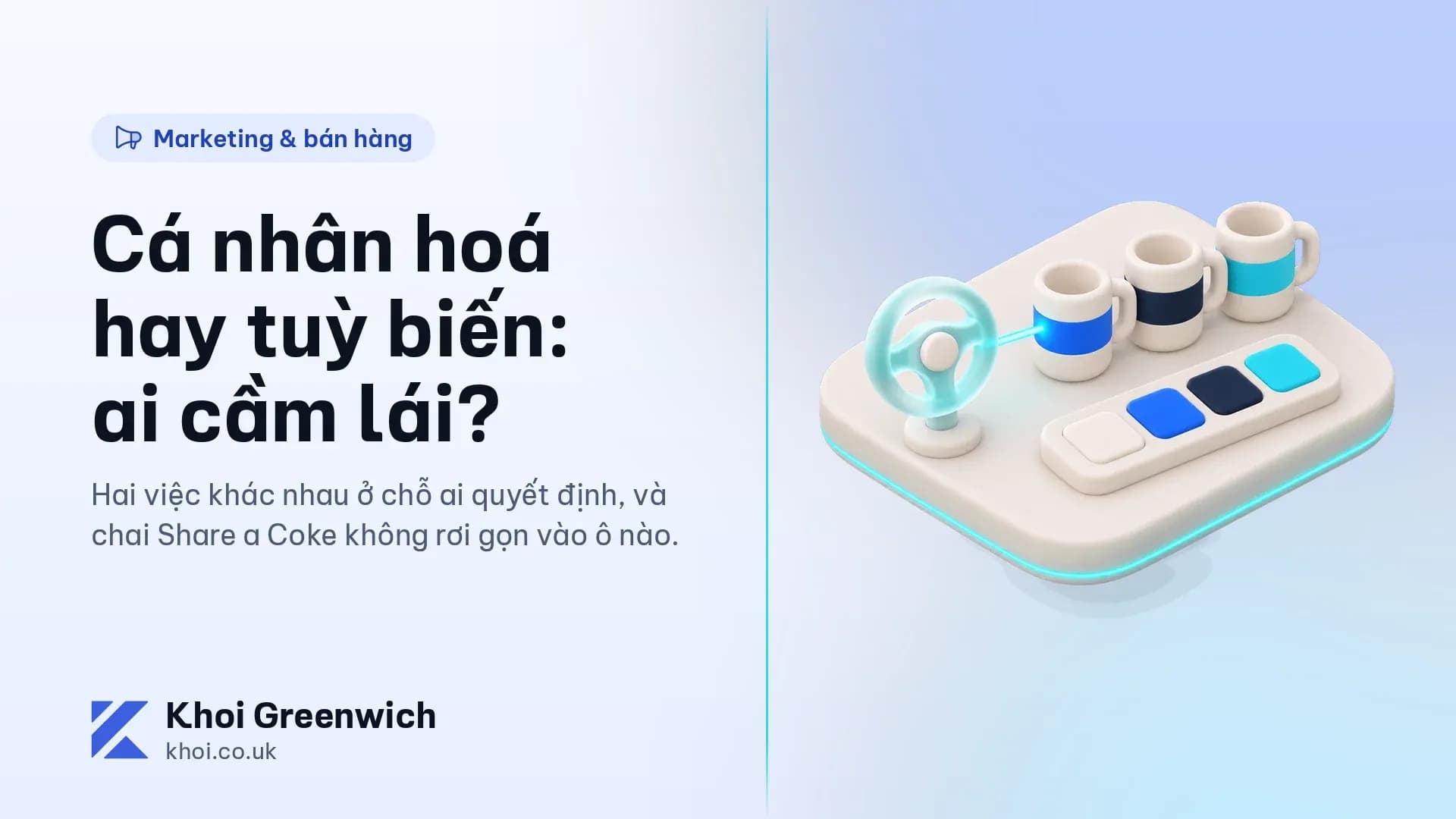
Cá nhân hoá hay tuỳ biến: ai cầm lái?
Gợi ý phim trên Netflix và bảng chọn cấu hình máy tính Dell thường bị gọi chung là cá nhân hoá, dù quyền quyết định nằm ở hai phía ngược nhau. Phân biệt rõ hai cơ chế này cùng bài toán 36 SKU của xưởng cà phê online giúp chủ shop chọn đúng mô hình lai RFM mà không vỡ tồn kho.
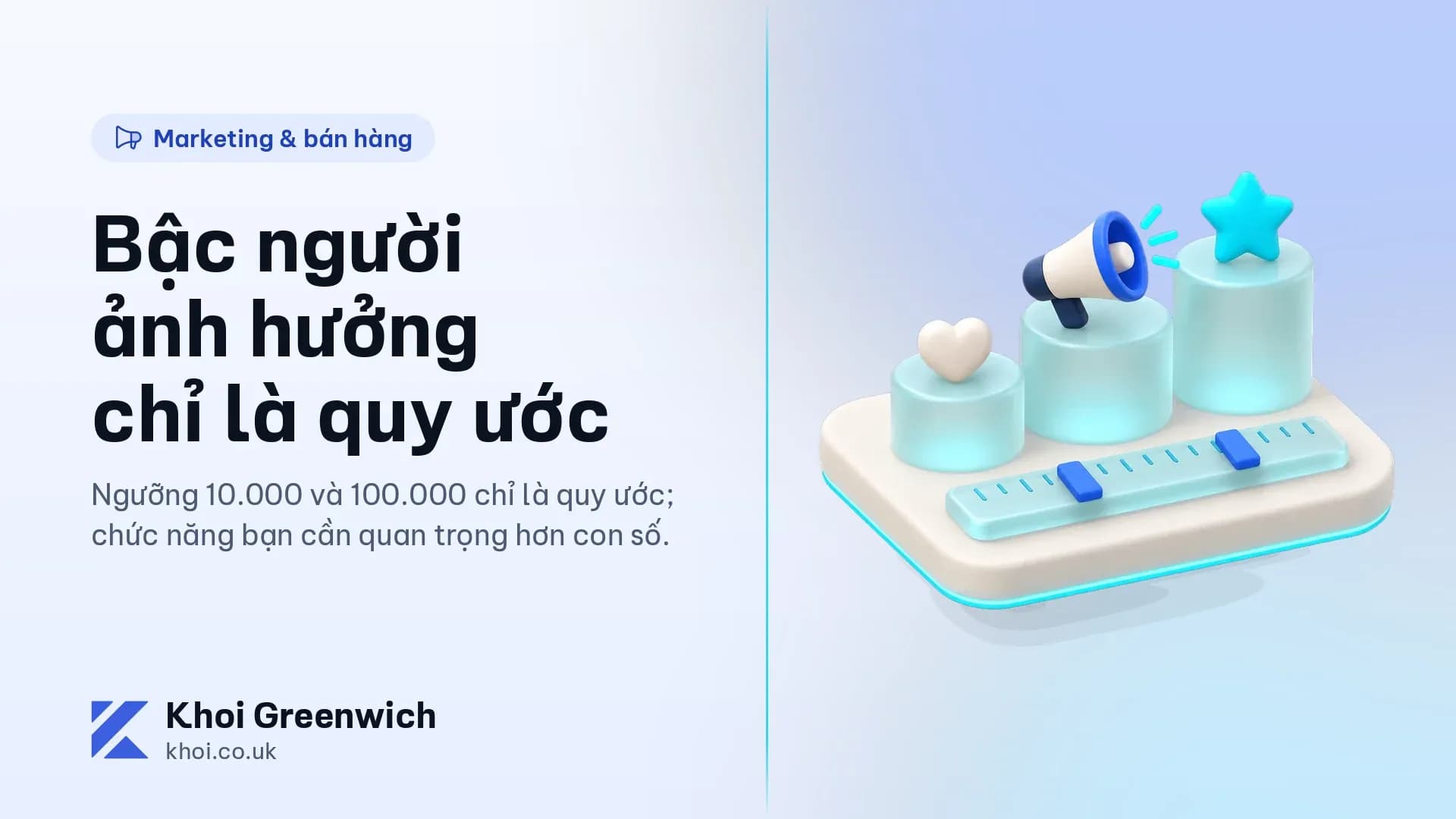
Chọn influencer: đừng chỉ nhìn số người theo dõi
Cầm 30 triệu đồng test sản phẩm mới, nên book một kênh 300.000 follower hay chia cho mười KOC nhỏ? Các bậc nano, micro hay macro trong báo giá chỉ là quy ước làm tròn; hiệu quả thật phụ thuộc vào lượt hiển thị đúng tệp mua, niềm tin người xem và giờ công điều phối.
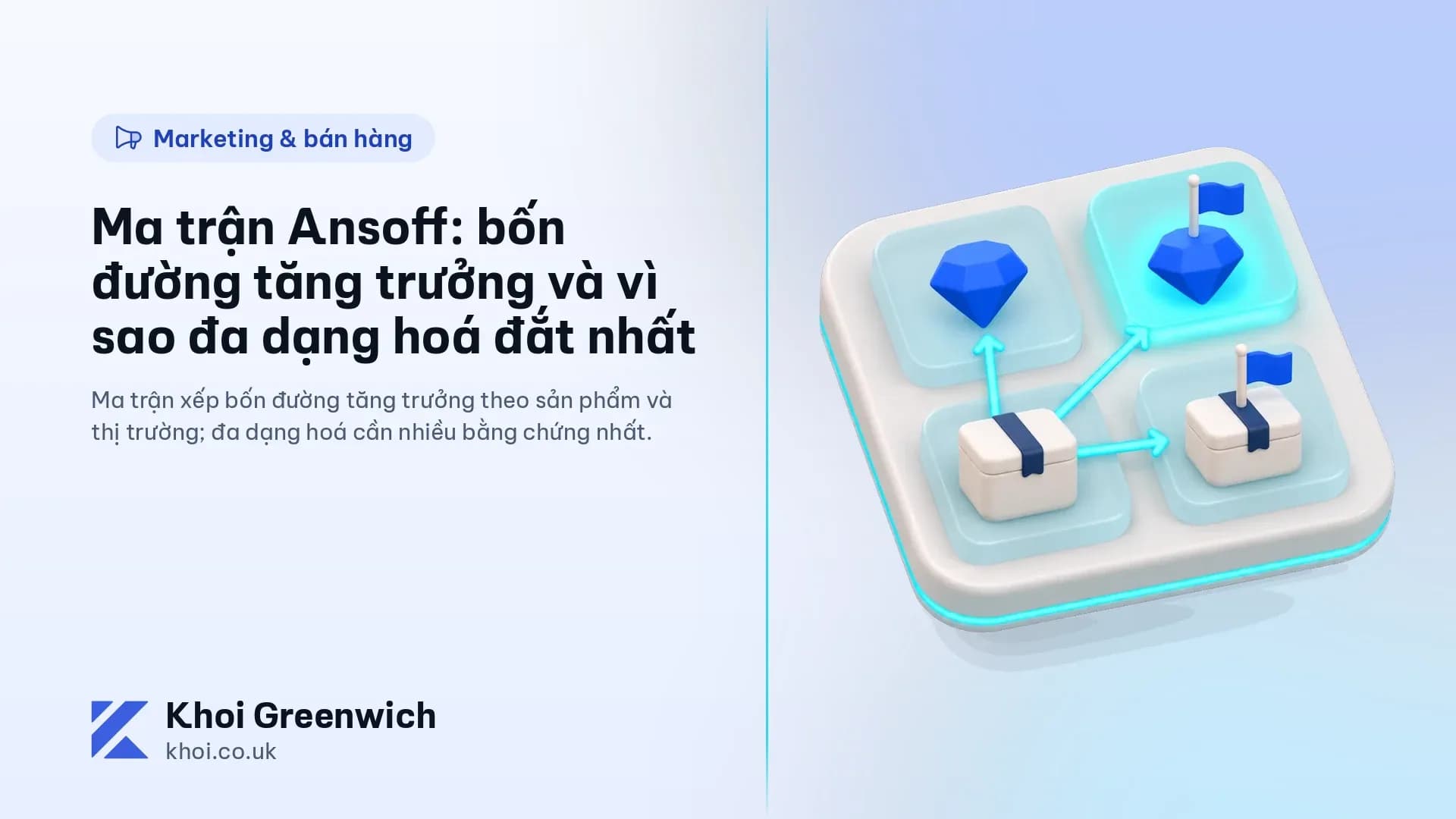
Ma trận Ansoff: bốn đường tăng trưởng và vì sao đa dạng hoá đắt nhất
Nhận chỉ tiêu tăng 20% doanh thu năm tới trên vốn lưu động mỏng, bạn nên đẩy sâu kênh cũ hay mở mảng bán lẻ mới? Ma trận Ansoff xếp bốn đường tăng trưởng theo sản phẩm và thị trường, chỉ rõ vì sao đa dạng hoá ngốn nhiều tiền mặt và bằng chứng nhất.