

Recurring Problems: The Iceberg, Lammsbräu and Shonaquip
Hiring month-end temp packers six months running still leaves 150 orders stuck in month seven: surface fixes rarely cure recurring snags. How the iceberg model exposes KPI distortions, tested on Neumarkter Lammsbräu and ShonaquipSE.

Director, KDIGI
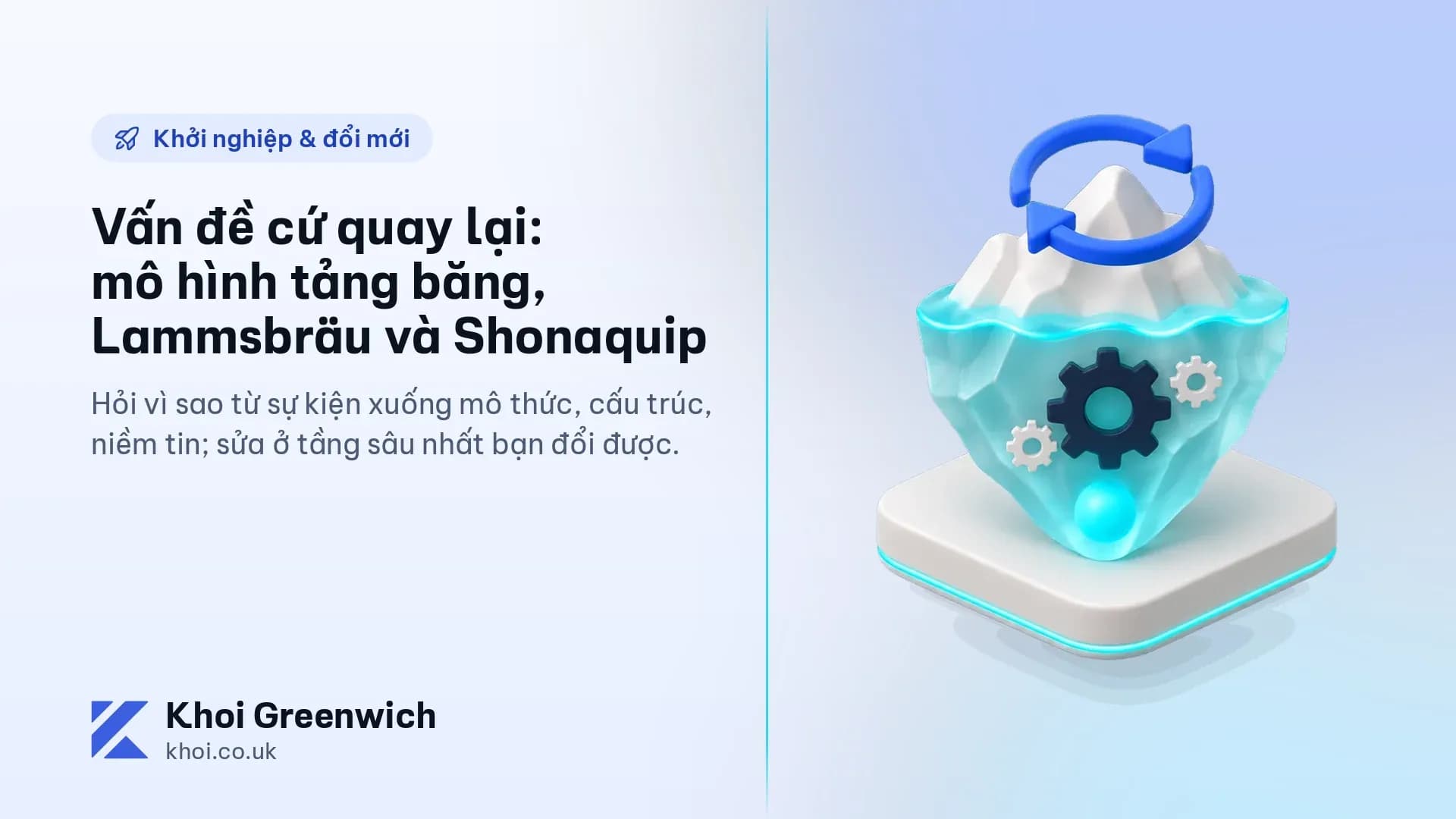
Suppose an online homeware retailer hires six temporary packers for the final five days of six consecutive months, yet month seven still ends with 150 overdue parcels stacked on the dispatch floor. Operational headaches that keep returning on schedule despite extra overtime or agency staff almost always stem from internal rules and KPIs underneath (Goodman, 1997). Walking an e-commerce fulfilment bottleneck through the iceberg model alongside public records from Neumarkter Lammsbräu in Germany and ShonaquipSE in South Africa shows how structural fixes differ from surface patching.
Using the four-layer iceberg model to clear a 150-order month-end backlog
Michael Goodman (1997) defines systems thinking as stepping back from isolated flare-ups to trace patterns over time and redesign the rules generating them (Goodman, 1997). He offers a crisp diagnostic test for management meetings: if a review concludes simply that the team lacked headcount or budget, analysis has stopped at the surface symptom (Goodman, 1997).
Iceberg model
When the same problem keeps coming back despite earlier fixes, what should a team leader or business owner ask to find the structures and mental models producing it?
- Top to bottom
- EventsWhat happened? The visible part.
- PatternsWhat has been happening? Which trends have emerged?
- StructureWhat is producing the patterns? In organisations, often policies and procedures.
- Mental modelsWhich beliefs, values and assumptions sit behind the structures and shape how we read everything above?
Put illustrative figures onto that online retailer to compare event patching against structural redesign. Monthly volume averages 3,000 orders, and the permanent warehouse crew packs up to 150 parcels a day cleanly. Across days 1 to 25, 2,100 orders arrive (84 a day), leaving benches comfortably under capacity. Then 900 orders (30 per cent of monthly volume) land in the final five days at 180 parcels a day, exceeding the 150-parcel daily cap and leaving 150 orders unshipped (16.7 per cent of peak intake).
| Iceberg layer | Diagnostic question | What happens in the e-commerce warehouse | Intervention and operational result |
|---|---|---|---|
| 1. Events | What visible snag just hit operations? | Month-end closes with 150 unshipped parcels, cancellations and support complaints | Hire 6 temp packers: clears the pile briefly, pushes SKU mispicks from 2% to 5% due to unfamiliar bin layouts, and repeats next month |
| 2. Patterns | Which trend repeats across multiple cycles? | Six months running, 30 per cent of monthly orders bunch into the final five days | Warehouse manager asks sales for advance warning of promo drops to juggle shift rotas |
| 3. Structure | Which KPIs and workflows create that spike? | Sales commissions close at 23:59 on month-end booked orders; marketing drops unscheduled flash vouchers without checking packing capacity | Pay sales commission on delivered orders; require five days' notice on voucher campaigns with daily redemption caps |
| 4. Mental models | Which unspoken belief keeps old rules intact? | Assumption that sales finishes at checkout while warehousing is a passive cost centre | Shared completion standard: revenue counts when accurate orders arrive on time, tracked via a joint On-Time In-Full (OTIF) metric |
Once commissions track delivered orders and promotional vouchers are spaced across the month, suppose the final five-day order share drops from 30 per cent to 20 per cent (600 parcels, or 120 a day). Daily volume stays safely inside the permanent crew's 150-parcel ceiling: the 150-order backlog vanishes, temp spend drops to zero and mispicks hold steady at 2 per cent.
Following Cunliff's (2004) verification rule, management should track that five-day order share across two or three monthly closes to confirm the fix holds (Cunliff, 2004). In my experience, cross-departmental bottlenecks resolve fastest when sales, marketing and fulfilment sit around one daily order-flow chart to fix shared incentives without trading blame (Goodman, 1997).
Why Neumarkter Lammsbräu locks in above-market contracts with 170 organic farms
Viewed strictly at the event tier, malting barley and hops are spot commodities: when local organic grain tightens, buyers ring brokers for the cheapest available load. Public disclosures from Bavarian organic brewer Neumarkter Lammsbräu illustrate what structural supply-chain redesign looks like instead (see the Lammsbräu case):
| Iceberg layer | Evidence documented in Neumarkter Lammsbräu disclosures |
|---|---|
| Events | Became Europe's first brewery certified under EC organic standards in 1992; converted its entire product range to 100 per cent organic by 1995 (Neumarkter Lammsbräu, n.d.) |
| Patterns | Founded the EZÖB organic brewing-grain producer association in 1989, maintaining supply links across roughly 170 regional family farms (Neumarkter Lammsbräu, n.d.; Neumarkter Lammsbräu, n.d.) |
| Structure | Multi-year off-take contracts at prices consistently above market averages; over a decade of co-funding for Kulturlandpläne (soil, water and biodiversity plans); 100 per cent Ehrnsperger family ownership since 1800 (Neumarkter Lammsbräu, n.d.; Neumarkter Lammsbräu, n.d.) |
| Mental models | Corporate philosophy of "Enkeltauglichkeit" (operating in a way fit for grandchildren), backed by a formal ecological charter since 1977 that ranks long-term stewardship ahead of short-term tactics (Neumarkter Lammsbräu, n.d.; Neumarkter Lammsbräu, n.d.) |
Farm unit economics explain why that contract design endures. Converting conventional fields to certified organic grain inflicts three years of lower yields and soil investment before a single organic premium arrives. Spot purchasing would drive growers back to chemical inputs after one bad price swing; multi-year price floors inside EZÖB share conversion risk so the brewery secures traceable regional grain (Neumarkter Lammsbräu, n.d.).
That structure carries clear commercial conditions: higher raw-material costs require durable premium retail pricing and private family ownership insulated from quarterly equity pressure (Neumarkter Lammsbräu, n.d.). Public company documents also omit exact grain-pricing formulas and harvest-shortfall clauses.
Why ShonaquipSE expanded from wheelchair manufacturing to clinical training and policy
Practitioner research by Trafford et al. (2021, with three of the five authors affiliated with ShonaquipSE) demonstrates why delivering a rugged wheelchair achieves very little inclusion if rural clinics cannot fit seating and local schools bar disabled children (Trafford et al., 2021) (see the Shonaquip case):
| Iceberg layer | Evidence from Trafford et al. (2021) and annual impact reports |
|---|---|
| Events | Founded in Cape Town in 1992 after Shona McDonald's daughter was born with cerebral palsy; children were tied into cardboard-padded pushchairs causing spinal damage, while donated urban wheelchairs broke on unpaved tracks (Trafford et al., 2021) |
| Patterns | Custom devices still went unused where clinics lacked seating therapists and repair parts; Shonaquip added clinical assessments, staff training and launched the Uhambo Foundation in 2010 (Trafford et al., 2021) |
| Structure | Public health faces multi-year waiting lists and severe therapist shortages (Trafford et al., 2021). Internally, a three-entity hybrid channels manufacturing surpluses from Shonaquip (Pty) Ltd into social programmes (ShonaquipSE, 2025); 60% of chairs go via state tenders and 30% via NGOs (Trafford et al., 2021) |
| Mental models | "Ecosystems for inclusion" philosophy shifting from passive charity towards human rights (treating environmental barriers as disabling) and co-working with families (Trafford et al., 2021; ShonaquipSE, 2025) |
Operating across manufacturing, state training and community advocacy addresses systemic barriers while placing heavy strain on liquidity. In its 2024–2025 report, Shonaquip (Pty) Ltd lifted revenue by 10.2 per cent from R39.1 million to R43.1 million, yet cash reserves stood at R1.518 million, just 37 per cent of its R4.1 million safety target (ShonaquipSE, 2025).
Over the same year, the non-profit Uhambo arm recorded an operating deficit of R868 thousand once internal cross-subsidies were replaced with transparent cost allocation (ShonaquipSE, 2025). Relying on government tenders for 60 per cent of sales leaves group working capital exposed whenever provincial health departments delay invoice settlement.
When structural fixes count as social innovation and when to stop digging
The Three elements of social innovation framework from Moulaert, MacCallum and Hillier (2013) separates ordinary workflow redesign from genuine social innovation across three tests: meeting neglected human needs, reconfiguring social relations and building collective empowerment (Moulaert et al., 2013).
| Social innovation dimension | Assessment of Neumarkter Lammsbräu | Assessment of ShonaquipSE |
|---|---|---|
| Meeting neglected human needs | Serves commercial organic beer buyers while stewarding regional farmland (Neumarkter Lammsbräu, n.d.) | Supplies postural mobility devices for low-income disabled children amid over 2.5 billion people globally needing assistive tech per WHO and UNICEF (2022) (World Health Organization and United Nations Children's Fund, 2022) |
| Reconfiguring social relations | Replaces adversarial spot grain buying with multi-decade risk sharing across EZÖB (Neumarkter Lammsbräu, n.d.) | Turns passive clinic waiting lists into joint problem solving between parents and public therapists (Trafford et al., 2021) |
| Empowerment and political voice | Disclosures show no farmer voting seats on the brewery's governing board (Neumarkter Lammsbräu, n.d.) | Backs the parent-run Champions of Change Trust, where parent advocates led 133 of 160 community workshops (ShonaquipSE, 2025) |
In day-to-day management, reserve the iceberg model for chronic loops that have resisted two or three straightforward fixes (Goodman, 1997); acute server outages or cash emergencies call for immediate containment first. Managers should also guard against survivorship bias: Lammsbräu and ShonaquipSE survived three decades, whereas many guaranteed-floor buyers and multi-entity hybrids ran out of working capital early.
Going deeper: System-dynamics origins and three critiques of the iceberg model
The four-tier iceberg metaphor grew out of Jay Forrester's System Dynamics work at MIT Sloan and entered mainstream management practice through Peter Senge in the 1990s. Michael Goodman (1997) distilled the diagnostic questions in The Systems Thinker to curb reactive management (Goodman, 1997), and Edward Cunliff (2004) tied the tiers to longitudinal trend charts so teams could locate high-impact intervention points (Cunliff, 2004).
Both Goodman (1997) and Cunliff (2004) wrote practitioner guides based on consulting experience, so sketching a plausible diagram produces a working hypothesis that still needs data verification. Three academic critiques help keep workshops grounded.
Formal structures and mental models overlap constantly because written incentives and unspoken beliefs reinforce one another (Goodman, 1997). Unbounded workshops can also drift into analysis paralysis, debating deep cultural traits while postponing simple KPI experiments next week. Above all, as Moulaert et al. (2013) note, diagnosing a flawed institutional rule does not automatically grant operational managers the political authority required to overturn it (Moulaert et al., 2013).
Quick questions
How do system structures differ from mental models inside a business?
Structures are documented rules, KPI formulas and sign-off routines you can audit on paper, such as closing sales commissions at 23:59 on the final day of the month. Mental models are the unexamined beliefs that make those rules feel natural (Goodman, 1997). Whenever a counterproductive workflow survives repeated complaints, an unspoken assumption is usually protecting it.
How should a team verify whether a structural change actually solved the problem?
Cunliff (2004) advises tracking continuous time-series data across several operating cycles rather than celebrating a single quiet week (Cunliff, 2004). Monitor a metric tied directly to your structural change (for example, the percentage of monthly orders arriving in the last five days) across two or three closes, and revise the hypothesis if the curve fails to flatten.
Where should managers stop asking "why" during root-cause reviews?
Stop at the deepest layer where leadership in the room holds real authority and budget to rewrite the rules. Pushing further into broad societal habits outside company control breeds frustration and stalls execution (Goodman, 1997); record those wider forces as external risk constraints instead.
Can the iceberg model diagnose customer churn and market shifts?
Yes, provided inputs come from actual purchase logs and interviews with lost customers rather than internal guesswork (Goodman, 1997). Bring sales, marketing, support and fulfilment leads together so no single function projects its own blind spots onto buyer behaviour.
References
Listed A–Z by author surname, Harvard style. A source with a DOI links to https://doi.org/…; one without links to its page or says plainly that it has no DOI.
- Cunliff, E. (2004) ‘Connecting systems thinking and action’, The Systems Thinker, 15(2), pp. 7–10.No DOIthesystemsthinker.comCited in 1 article
- Goodman, M. (1997) ‘Systems thinking: what, why, when, where, and how?’, The Systems Thinker, 8(2), pp. 6–7.No DOIthesystemsthinker.comCited in 1 article
- Moulaert, F., MacCallum, D. and Hillier, J. (2013) ‘Social innovation: intuition, precept, concept, theory and practice’, in The international handbook on social innovation: collective action, social learning and transdisciplinary research. Cheltenham: Edward Elgar, pp. 13–24.doi:10.4337/9781849809993.00011Cited in 1 article
- Neumarkter Lammsbräu (n.d.) Erzeugergemeinschaft für Bio-Braurohstoffe.No DOIlammsbraeu.deCited in 1 article
- Neumarkter Lammsbräu (n.d.) Über uns.No DOIlammsbraeu.deCited in 1 article
- ShonaquipSE (2025) A world designed for everyone: ShonaquipSE annual impact report FY 2024–2025.No DOIshonaquipse.org.zaCited in 1 article
- Trafford, Z. et al. (2021) ‘More than just assistive devices: how a South African social enterprise supports an environment of inclusion’, International Journal of Environmental Research and Public Health, 18(5), article 2655.doi:10.3390/ijerph18052655Cited in 1 article
- World Health Organization and United Nations Children's Fund (2022) Global report on assistive technology.No DOIiris.who.intCited in 1 article
Related articles

Capturing value from innovation: Teece's three questions
EMI invented the CT scanner yet lost market leadership within six years, whereas IBM shipped over 500,000 PCs built from off-the-shelf components. When rivals can copy your hardware in months, Teece's (1986) three questions show which bottleneck founders must own.
Feasibility before the business plan: four gates, one idea
Holding VND 150 million in savings for a 24-hour coastal homestay laundry is no reason to draft a thirty-page business plan first. Six working days and VND 2.3 million across four feasibility gates uncover a VND 95 million equipment gap and a steep slack-season break-even.

Keurig Kold withdrawn: what the public record can and cannot show
Less than ten months after launching its US$299–369 cold-drink machine with single-use pods, Keurig halted production, refunded buyers in full and cut around 130 jobs. What press coverage confirms and leaves blank yields five unit-economics checks before paying for tooling.
Was this article useful?
No ratings yet.
Comments (0)
No comments yet. Be the first.