

“I consent” is not enough: privacy as a public good
When 700 loyalty-app members sync their phone contacts for a voucher, 126,000 strangers' numbers can land on your server without a single consent tap from them. Individual consent boxes miss network externalities completely; data minimisation and shareable referral links fix the leak at source.

Director, KDIGI
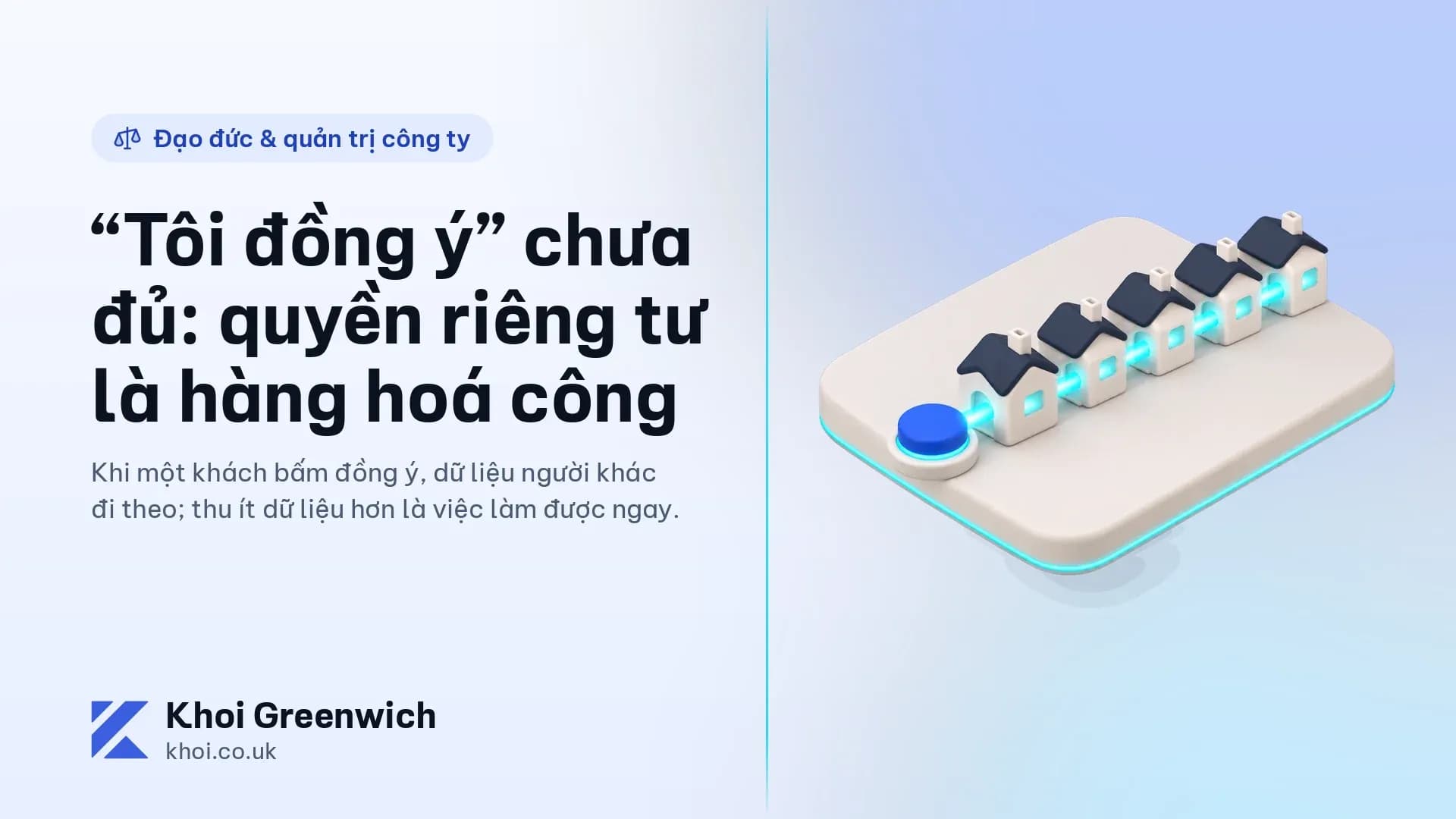
Many retail and growth teams assume that once every registered app member ticks “I agree to the privacy policy”, the company's CRM database sits on clean legal ground. Look inside the contact tables of a refer-a-friend campaign and a very different picture emerges: whenever an app asks users to sync their phone books, tens of thousands of strangers who never saw your terms get pulled onto your servers. Joshua Fairfield and Christoph Engel's (2015) economic analysis, alongside the £500,000 ICO penalty against Facebook, explains why individual consent screens miss network leaks and how product owners can build cleaner acquisition funnels (Fairfield and Engel, 2015, p. 387; Information Commissioner's Office, 2018).
How can 700 consenting users pull 126,000 strangers into your CRM?
Digital data is relational at every layer: one person's address book, calendar or inbox automatically exposes names, numbers and routines belonging to colleagues, relatives and clients (Fairfield and Engel, 2015, p. 403). Fairfield and Engel (2015, p. 387) open their paper with a blunt summary: your privacy is not yours alone. Once one user grants device permissions, their phone acts as a conduit siphoning data across their social circle regardless of what anyone else in that circle wanted (Fairfield and Engel, 2015, p. 410).
Put numbers on that spillover through a worked retail hypothetical. Suppose a bakery chain in a provincial town of 100,000 residents runs a loyalty app with 2,000 registered customers. Marketing launches an “Invite a friend for a free pastry” prompt requesting contact-book sync; 35 per cent of members (700 users) tap allow, and each handset stores 180 contacts on average.
The bakery's server ingests: 700 × 180 = 126,000 contact rows That unconsented table is 63 times larger than the shop's entire registered membership.
Under random mixing across 100,000 townsfolk, a resident's chance of staying out of one 180-person contact list is 1 − (180 / 100,000) = 0.9982, and their chance of missing all 700 uploaded lists is (0.9982)⁷⁰⁰ ≈ 0.2833. The probability that a random resident's phone number lands on the bakery's database reaches: 1 − 0.2833 = 0.7167 ≈ 72 per cent
Up to 72,000 residents could be logged even though only 700 people (0.7 per cent of the town) ever tapped agree. Real social networks cluster tightly around workplaces and neighbourhoods, so heavy overlap makes 72 per cent a theoretical ceiling under random assignment; even with 50 per cent overlap, the retailer still holds tens of thousands of unconsented records. Where Five questions to ask before you trust a chart asks who is missing from a sample, a CRM privacy audit asks the reverse: who is sitting inside our tables without ever having been asked?
The ICO's £500,000 fine against Facebook on 25 October 2018 (the statutory cap under pre-GDPR UK law) showed that exact failure at global scale (Information Commissioner's Office, 2018). Platform rules let third-party developers pull data on users' friends without clear consent; a single quiz app collected records on up to 87 million people worldwide and affected at least one million UK residents (Information Commissioner's Office, 2018) (see the Facebook and Cambridge Analytica case study).
Judging purely on funnel conversion and unit economics, I find contact-book scraping self-defeating anyway. Strict iOS and Android OS permission warnings routinely scare off 40 to 60 per cent of users mid-referral, while storing 126,000 cold numbers inflates breach liability for zero extra revenue. Issuing a personal referral link that members paste into WhatsApp or Zalo converts higher-intent leads while keeping strangers' phone books off your infrastructure.
Four CRM and product safeguards for SME digital teams
An independent retailer cannot fix data externalities across the wider internet, yet product managers and business owners govern every field their own sign-up forms, loyalty apps and landing pages collect:
| Product discipline | Statutory and academic basis | Practical CRM and app implementation |
|---|---|---|
| Data minimisation | UK GDPR Art. 5(1)(c) (European Parliament and Council, 2016); Vietnam Law 91/2025/QH15 Art. 3(2); bloated databases attract attackers (Fairfield and Engel, 2015, p. 401) | Drop contact-list syncing altogether; issue unique referral links or codes that customers forward themselves |
| Closed defaults and auto-purge | UK GDPR Art. 25(2): process only data necessary for each specific purpose and retention window by default (European Parliament and Council, 2016) | Leave background location off by default; schedule automated deletion or anonymisation for dormant accounts |
| Unbundled permission toggles | Separate switches curb excess data capture (Fairfield and Engel, 2015, p. 450); Law 91/2025/QH15 Art. 9(4)(a) | Separate promotional messaging consent from store-finder location and QR-scanner camera access |
| Other-regarding prompt copy | Framing choices around protecting friends lifts cooperation better than personal risk warnings (Fairfield and Engel, 2015, pp. 454–455) | Referral screen copy: “Protect your friends' privacy: share this voucher link directly; we never read your contacts” |
When auditing lead-capture forms, I also cut habit-driven demographic fields. Fairfield and Engel (2015, p. 390) cite Latanya Sweeney's classic demonstration that five-digit postcode, gender and full date of birth uniquely identify 87 per cent of the US population. Storing birth month alone runs birthday voucher automation cleanly without turning a retail CRM into an identity vault.
Modern statutes tighten individual consent quality without closing third-party leaks automatically. Both the UK GDPR (requiring withdrawal of consent to be as easy as giving it (European Parliament and Council, 2016, Art. 7(3))) and Vietnam's Law on Personal Data Protection (Law No. 91/2025/QH15, effective 1 January 2026) ban bundled consent conditions and silence-as-consent (Article 9).
Screen prompts still reflect individualism bias by addressing only the handset owner (Fairfield and Engel, 2015, p. 409), while Article 4(2)(b) of Law 91/2025/QH15 reminds citizens to respect others' data. Although Article 38(3) exempts micro-enterprises and household traders from impact assessments (Articles 21–22) and data-protection officers (Article 33(2)) outside sensitive or large-scale processing, core rules in Articles 3 and 9 bind every firm.
Privacy as a public good: the 100-user social dilemma
Economists classify network privacy as a public good—or from the angle of data leakage, an informational “public bad” comparable to urban smog (Fairfield and Engel, 2015, pp. 387–388). Whenever one shopper trades address-book access for a £2 voucher, they pocket the entire discount while bearing only a fraction of the resulting exposure; the remaining negative externality spills across everyone in their phone (Fairfield and Engel, 2015, p. 423).
Consider an illustrative 100-person group weighing a free mobile app. Installing delivers +6 points of private utility to the user, imposes −2 points of personal privacy loss and spills −0.1 points of shared exposure onto each of the other 99 people:
| Collective choice across 100 people | Net payoff per participant |
|---|---|
| Nobody installs the app | Every person stays at 0.0 points |
| Exactly 1 person installs | Installer nets +4.0 points; each of the 99 non-users takes −0.1 points |
| All 100 people install | Every participant finishes at −5.9 points |
Whatever everyone else chooses, any single person gains +4.0 points by installing (6 − 2), while inflicting 9.9 points of combined harm on the remaining 99 peers (99 × 0.1). Once all 100 act on private self-interest, everyone lands at −5.9 points (+4.0 − 9.9). Game theory calls this a dominant strategy producing a social dilemma (Fairfield and Engel, 2015, p. 422), leaving even holdouts exposed to predictive profiling built from neighbours' uploads (Fairfield and Engel, 2015, p. 411).
Privacy as a public-good dilemma
When a product team designs data-consent flows, how should it coordinate users so that one person's choice to share data does not expose others' privacy?
- Each person optimises their own benefit when sharing data
- One person's data reveals information about others (externality)
- Shared privacy falls below the level that is best for everyone
- Group coordination (communication, framing, sanctions, institutions) is needed to restore privacy
Behavioural public-goods experiments show that real groups cooperate far above bare Nash equilibrium predictions when members can communicate, observe peer norms or read prompts framed around group welfare (Fairfield and Engel, 2015, p. 391; Fairfield and Engel, 2015, p. 448). While retaining transparent notices, Fairfield and Engel argue that privacy rules must add group-level protections (Fairfield and Engel, 2015, p. 393) (see Privacy as a public-good dilemma).
Going deeper: Fairfield and Engel's collective-action model and its limits
Fairfield and Engel bridge Ronald Coase's transaction-cost economics and Elinor Ostrom's governance principles for common-pool resources (Fairfield and Engel, 2015, p. 421; Ostrom, 1990). Importing collective-action logic into privacy law explains why bilateral notice-and-choice fails whenever relational externalities dominate (Fairfield and Engel, 2015, p. 409). Their model aligns closely with Helen Nissenbaum's contextual integrity framework (Nissenbaum, 2010), which defines privacy around whether information flows honour context-specific social norms.
Three practical and theoretical boundaries apply when translating their paper into commercial product management. For a start, Fairfield and Engel combine legal reasoning with controlled laboratory public-goods games rather than live e-commerce split tests, noting explicitly that their proposals sketch new policy tools rather than a turnkey commercial specification (Fairfield and Engel, 2015, p. 435; Fairfield and Engel, 2015, p. 457).
Subsequent privacy scholars also point out that personal data behaves much like a depletable common-pool resource: disclosures from early adopters train machine-learning models to infer sensitive traits about holdouts, actively eroding non-users' shelter. Moreover, Ostrom-style peer governance tools proposed in the paper (user forums, social sanctions and pseudonymous reputation scores (Ostrom, 1990; Fairfield and Engel, 2015, pp. 451–454)) rely on tight-knit communities with repeat interaction, whereas retail shoppers tap screens in isolation against instant vouchers and dark patterns (Fairfield and Engel, 2015, pp. 454–455). In consumer commerce, engineering restraint (refusing to ingest third-party contacts at the database schema level) remains the surest defence.
Quick questions
Does a customer's uploaded contact book count as third-party personal data?
Under the UK GDPR and modern data-protection statutes, personal data covers any information relating to an identified or identifiable natural person (European Parliament and Council, 2016, Art. 4(1)). A name paired with a mobile number identifies a specific person even if they have never visited your shop. An uploaded address book therefore constitutes personal data for every individual listed inside it.
How does economics separate “a public good” from “the public good”?
Fairfield and Engel distinguish legal phrasing from microeconomics: 'the public good' refers to general civic welfare, whereas 'a public good' is technically non-excludable and non-rivalrous (Fairfield and Engel, 2015, pp. 414–415). Because nobody can wall themselves off from shared network leaks, individuals are tempted to claim small instant perks while passing the privacy loss onto everyone around them.
Can people protect their data simply by staying off consumer apps?
Fairfield and Engel show that abstaining gives incomplete protection because informational externalities travel through social ties (Fairfield and Engel, 2015, p. 411). Someone who refuses to install an app forfeits every convenience of the service yet still absorbs much of the exposure whenever friends, relatives or colleagues sync address books, calendars and email threads.
Does collecting fewer fields hurt customer acquisition and referral campaigns?
It narrows raw behavioral logs slightly, yet Fairfield and Engel point out that cutting privacy risk and compliance liability lifts net value directly (Fairfield and Engel, 2015, p. 398). In refer-a-friend flows, dropping address-book scraping in favour of unique invite links avoids permission-screen drop-off while keeping unconsented contacts off your CRM.
References
Listed A–Z by author surname, Harvard style. A source with a DOI links to https://doi.org/…; one without links to its page or says plainly that it has no DOI.
- European Parliament and Council (2016) Regulation (EU) 2016/679 (General Data Protection Regulation). Official Journal of the European Union.No DOIeur-lex.europa.euCited in 3 articles
- Fairfield, J.A.T. and Engel, C. (2015) ‘Privacy as a public good’, Duke Law Journal, 65(3), pp. 385–457.No DOIscholarship.law.duke.eduCited in 2 articles
- Information Commissioner's Office (2018) ICO issues maximum £500,000 fine to Facebook for failing to protect users’ personal information. ICO news and blogs.No DOIico.org.ukCited in 1 article
- Nissenbaum, H. (2010) Privacy in context: technology, policy, and the integrity of social life. Stanford, CA: Stanford University Press.doi:10.1515/9780804772891Cited in 2 articles
- Ostrom, E. (1990) Governing the commons: the evolution of institutions for collective action. Cambridge: Cambridge University Press.doi:10.1017/cbo9780511807763Cited in 1 article
Related articles

UK intellectual property: which rights arise automatically?
Vietnamese trade mark, design or patent certificates stop at the border the day your goods go on sale in Britain. Mapping the six intellectual property rights under UK statute separates automatic protections from UK IPO registrations and locks in Paris Convention priority deadlines.

Cheap garment factories: keep or cut, and who decides?
An overseas garment subcontractor sewing 30 per cent of your CMT outerwear fails a social audit, yet machinists say they still need the jobs. Four consent gates from Zwolinski, Kates and Human Rights Watch guide the choice between dated fixes and a phased exit.
CEO pay at 290 times a worker: a ratio is not a verdict
Is a 1.8 billion VND managing director salary unfair when warehouse staff earn 84 million VND a year? The EPI's 290:1 headline is a prompt to check governance: under Rawls, fairness turns on who sets pay and whether the lowest-paid group gains from the gap.
Was this article useful?
No ratings yet.
Comments (0)
No comments yet. Be the first.