

Personalisation or customisation: who holds the controls?
Netflix film rankings and Dell build-to-order configurators often get bundled together as personalisation, yet opposite sides make the choice. Separating both mechanisms, alongside a 36-SKU online coffee roastery calculation, shows why most small shops win with a simple RFM hybrid.

Director, KDIGI
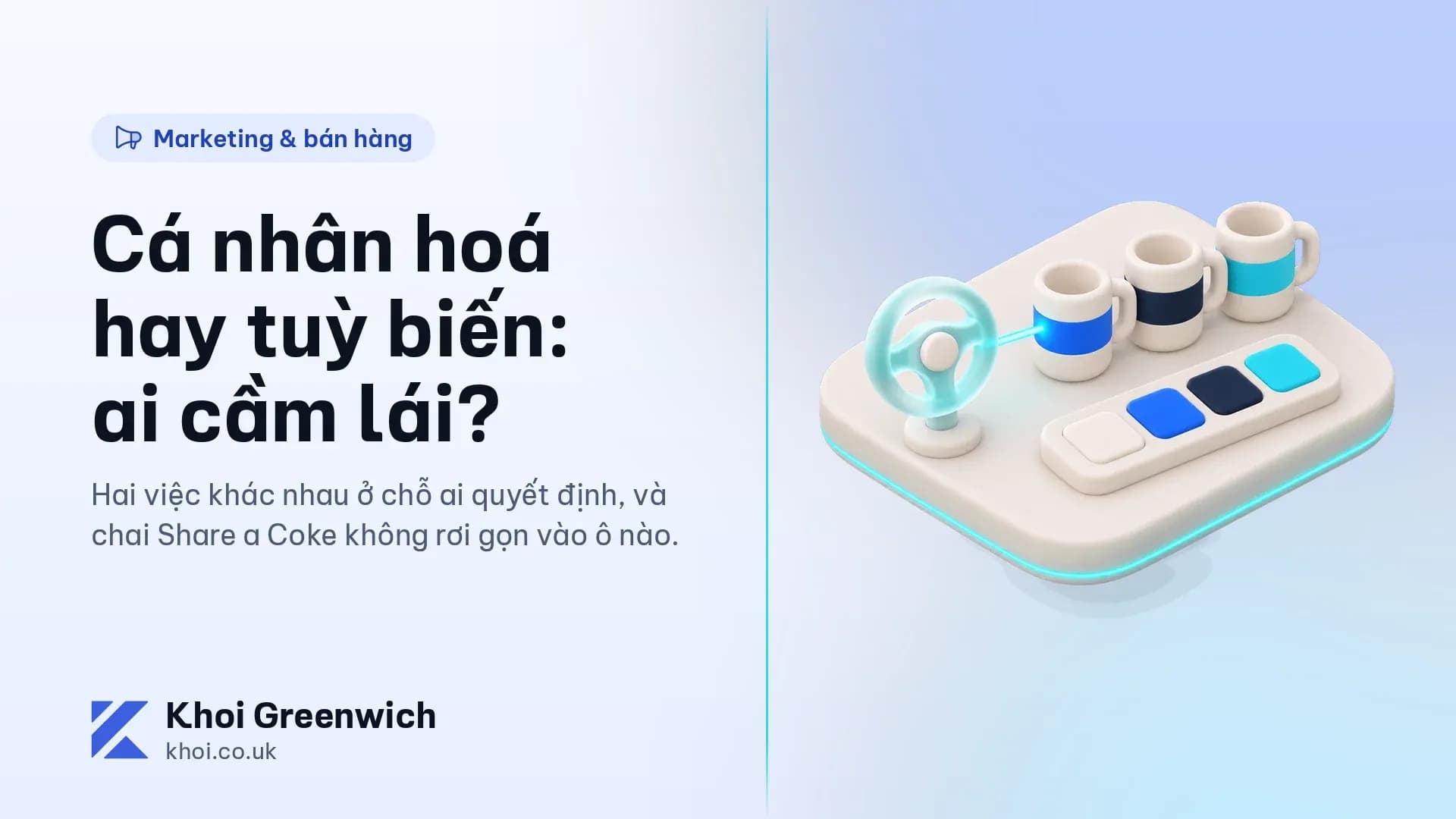
The practical distinction between personalisation and customisation comes down to who holds the controls over the final offer. When a firm uses past behavioural data to choose which product, message or price an individual sees, that is personalisation; when the shopper actively configures attributes before checkout, that is customisation (Arora et al., 2008). Keeping those two mechanisms separate stops online retailers from overspending on brittle prediction pipelines or drowning their packing bench in slow-moving SKU variants.
How do personalisation and customisation differ in workflow and unit economics?
Under Arora and colleagues' (2008) definition, the boundary lies in whether the seller or the buyer determines the marketing mix (Arora et al., 2008). Amazon ranking book suggestions from reading history is personalisation; Dell letting a customer pick processor, memory and storage before assembly is customisation.
Both trade press and academic titles blur this line. Arora and colleagues point to Ansari and Mela's (2003) paper on email customisation: despite the title, their model scanned clickstream logs so the server could choose which links and copy appeared in each subscriber's email (Ansari and Mela, 2003). Because the firm controlled the layout for every recipient, the system operated as personalisation (Arora et al., 2008).
Personalisation versus customisation: two five-stage processes
When a marketing team designs one-to-one offers, should the firm personalise them from customer data or let customers customise the offer themselves?
| Criterion | Personalisation (system-led) | Customisation (user-led) |
|---|---|---|
| Stage 1 | Data collection | Interface set-up |
| Stage 2 | Segmentation and profiling | Choosing options |
| Stage 3 | Matching content and offers | Preview and confirm |
| Stage 4 | Real-time delivery | Ordering |
| Stage 5 | Feedback loop improves the algorithm | Production and delivery |
Across five operating stages from data capture to dispatch, the two approaches carry opposite unit economics:
- Personalisation logs implicit behaviour, scores conversion probability in the background and dispatches standard pre-packed SKUs. Upfront data engineering and modelling costs are high, yet marginal cost per additional impression sits near zero.
- Customisation presents an explicit configurator, renders a live preview for buyer approval and generates an individual bill of materials for small-batch assembly. Upfront data modelling stays light, while unit handling time, component buffer stock and fulfilment lead times rise on every order.
Should a small online shop pick personalisation, customisation or an RFM hybrid?
Choosing the right setup depends on repeat-order depth, the cost of a wrong guess and fulfilment agility. Five diagnostic questions adapted from Arora and colleagues' (2008) operational trade-offs frame the decision (Arora et al., 2008):
| Operational diagnostic question | Favours personalisation when | Favours customisation when |
|---|---|---|
| How deep is repeat purchase history? | Frequent repeat orders reveal stable preferences | First-time visitors carry zero purchase logs |
| What is the penalty for a wrong guess? | Low: an off-target banner is simply scrolled past | High: shipping the wrong spec loses the account |
| Can buyers state exact technical specs? | Everyday shoppers struggle to name flavour notes | Experienced buyers know their exact brew setup |
| How manageable is SKU proliferation? | Wide option matrices trigger cart abandonment | Compact menus stay intuitive for buyers |
| How flexible is packing and dispatch? | Pre-packed stock ships same-day from shelves | Buyers accept made-to-order roasting lead times |
Take an illustrative online coffee roastery serving 800 repeat customers who have ordered at least twice. Management weighs three checkout designs: Option A uses homepage personalisation to push a single predicted bag at login; Option B offers full customisation across 3 roast levels (light, medium, dark) × 3 grinds (whole bean, filter, espresso) × 4 bean origins; Option C uses a hybrid basket pre-filled with the returning customer's last order alongside quick toggles to change roast or grind.
Working through the roastery maths exposes how fast Option B clogs inventory. Three roasts × three grinds × four bean lines create 36 SKU combinations. Even if beans are ground only at packing, the roastery still has to hold 3 × 4 = 12 separate bins of roasted whole beans. Roasted coffee loses peak aroma after three to four weeks; splitting 800 regulars across 12 bins leaves slow bin turnover, forcing wasteful micro-batches while casual buyers stall at three technical drop-downs.
Option A fails from the opposite side: 800 accounts give collaborative filtering far too sparse a matrix to avoid misfires. Pushing a bright floral Arabica at a regular who drinks dark traditional phin coffee risks losing a loyal buyer.
Weighing conversion rate against roast freshness, I favour Option C built on simple RFM rules (recency, frequency, monetary value), matching Arora and colleagues' recommendation when behavioural logs are modest (Arora et al., 2008). Returning buyers reorder last month's bag in one tap with an obvious toggle if they switch brew gear, while first-time visitors pick from three clear house blends.
How does system-led personalisation work at Netflix?
Netflix engineered system-led personalisation to beat viewer choice overload. Former product leaders Carlos Gomez-Uribe and Neil Hunt (2015) observed that a typical member loses interest after 60 to 90 seconds of scanning 10 to 20 titles without spotting something appealing (Gomez-Uribe and Hunt, 2015).
Netflix combines several algorithms led by its Personalised Video Ranker (PVR), which reorders catalogue rows per profile. Notably, Gomez-Uribe and Hunt report that PVR performs best when individual viewing history is blended with a substantial weight on overall catalogue popularity (Gomez-Uribe and Hunt, 2015). Retaining broad popularity prevents members from getting trapped inside narrow genre pockets and keeps widely discussed releases visible.
Streaming logs also highlight the gap between stated preferences and actual clicks: survey respondents regularly ask for acclaimed documentaries or classic cinema, yet Friday-night viewing tilts heavily towards light comedy and reality television. Product changes are therefore settled through live A/B experiments on streaming behaviour rather than questionnaires (Gomez-Uribe and Hunt, 2015). By company estimates, recommendations steer roughly 80 per cent of streamed hours against 20 per cent from search and preserve over $1bn a year through lower churn (Gomez-Uribe and Hunt, 2015) (see the Netflix case). Treat that $1bn figure with care: it pools internal retention estimates across multiple features without independent external verification.
Is Share a Coke personalisation, customisation or product proliferation?
Stacked in supermarket chillers, Coca-Cola's Share a Coke bottles belong to product proliferation rather than personalisation or customisation. The Coca-Cola Company's (2014) retrospective records that the campaign launched in Australia in 2011 by replacing the brand script with the country's 150 most popular first names, selling more than 250 million named packs that summer in a market of under 23 million people before rolling out to over 70 countries (The Coca-Cola Company, 2014).
Checked against Arora and colleagues' (2008) criteria, retail named cans sit outside one-to-one marketing (Arora et al., 2008). Coca-Cola drew its 150 names from national census popularity with zero personal data on individual supermarket shoppers, ruling out personalisation (The Coca-Cola Company, 2014). Nor did shoppers specify labels to the plant; rummaging through chilled shelves for a matching name is self-selection from fixed batch variants, or classic product proliferation (Arora et al., 2008).
Fast-moving consumer goods unit economics dictated that setup. Canning lines fill thousands of units per minute; halting production to print single custom names per buyer would destroy line efficiency and unit margins. Running large batches across 150 popular names kept mass-production economics intact while sparking social sharing. Genuine customisation stayed confined to promotional mall kiosks printing cans on site and a German web shop shipping bespoke named bottles for a delivery fee (The Coca-Cola Company, 2014) (see the Coca-Cola case). Keep in mind too that the 250 million pack figure lacks a prior-summer volume baseline and ran alongside heavy television and creator campaigns (The Coca-Cola Company, 2014).
Going deeper: cognitive load, personalised pricing traps and evidence limits
At the individual buyer level, Tam and Ho (2006) combined laboratory experiments and field surveys on web personalisation (Tam and Ho, 2006). Filtering out irrelevant options reduced search effort during initial shortlist formation, yet inaccurate recommendations pushed cognitive load straight back up and damaged trust in subsequent suggestions (Tam and Ho, 2006).
At commercial strategy level, Arora and colleagues (2008) document three practical limits across one-to-one marketing (Arora et al., 2008). Across the empirical studies available at the time, no systematic longitudinal proof showed personalisation raising long-term customer satisfaction, while aggressive tracking frequently provoked privacy pushback.
Price personalisation carries even sharper commercial danger. Although Rossi and colleagues' (1996) econometric simulation found household-level pricing lifted profit by 7.6 per cent over uniform pricing, charging two retail buyers different prices for identical stock destroys trust the moment regulars compare receipts. In live retail operations, I advise merchants against individualised pricing because rival pricing algorithms quickly spark margin-eroding price wars while one-to-one coupons barely beat segment offers net of admin costs (Arora et al., 2008).
On the customisation side, shoppers lacking technical expertise often assemble poor combinations unaided. When the bespoke item arrives and disappoints, buyers experience regret and conclude the standard off-the-shelf version was superior all along (Arora et al., 2008).
Conceptually, Arora and colleagues (2008) extended Black and Thomas's (2004) three-step cycle of data collection, customer insight and marketing action (Arora et al., 2008); the five-stage diagram in figure Figure 1 translates that cycle into e-commerce fulfilment. Readers should also keep methodological context on headline figures: Ansari and Mela's (2003) 62 per cent expected click-through lift is a statistical model ceiling (Ansari and Mela, 2003), while both Netflix's $1bn retention figure and Coca-Cola's 250 million packs come from unaudited corporate disclosures.
Quick questions
What is the core difference between personalisation and customisation?
The difference rests on who makes the decision. In Arora and colleagues' (2008) framework, personalisation occurs when the firm selects the marketing mix for an individual using previously collected behavioural data, whereas customisation occurs when the buyer actively specifies product attributes (Arora et al., 2008).
Was Coca-Cola's Share a Coke campaign personalisation or customisation?
Standard named bottles on supermarket shelves fit neither category; operationally, they are product proliferation. Coca-Cola printed 150 common Australian first names across mass production runs so shoppers could hunt for a match (The Coca-Cola Company, 2014). True customisation appeared only at mall printing kiosks and make-to-order online stores.
Does personalisation reliably increase long-term profitability?
Empirical findings are mixed. Arora and colleagues (2008) report that one-to-one pricing and individualised coupons beat segment-level targeting only marginally once operating costs are deducted, and they found no systematic empirical study proving sustained gains in long-term customer satisfaction (Arora et al., 2008).
What should a small online shop do without Netflix-scale behavioural data?
Run a lightweight hybrid built on RFM rules (recency, frequency, monetary value) inside your CRM. Pre-fill the basket with a returning buyer's previous order for one-tap repeat checkout while keeping clear toggles to adjust grind, size or variant before payment (Arora et al., 2008).
References
Listed A–Z by author surname, Harvard style. A source with a DOI links to https://doi.org/…; one without links to its page or says plainly that it has no DOI.
- Ansari, A. and Mela, C.F. (2003) ‘E-customization’, Journal of Marketing Research, 40(2), pp. 131–145.doi:10.1509/jmkr.40.2.131.19224Cited in 1 article
- Arora, N. et al. (2008) ‘Putting one-to-one marketing to work: personalization, customization, and choice’, Marketing Letters, 19(3-4), pp. 305–321.doi:10.1007/s11002-008-9056-zCited in 1 article
- Gomez-Uribe, C.A. and Hunt, N. (2015) ‘The Netflix recommender system’, ACM Transactions on Management Information Systems, 6(4), pp. 1–19.doi:10.1145/2843948Cited in 2 articles
- Tam, K.Y. and Ho, S.Y. (2006) ‘Understanding the impact of web personalization on user information processing and decision outcomes’, MIS Quarterly, 30(4), pp. 865–890.doi:10.2307/25148757Cited in 1 article
- The Coca-Cola Company (2014) How a groundbreaking campaign got its start ‘Down Under’. The Coca-Cola Company: history.No DOIcoca-colacompany.comCited in 1 article
Related articles

STP for new markets: choose customers before positioning
Entering a new city on a 60 million VND three-month budget leaves no room for a 7.7-month payback segment when another returns cash in 1.9 months. Practical STP prices CAC and operating capacity first, then anchors positioning to a promise buyers can verify on order one.
Five pricing strategies: a choosing table for SME launches
Marking up a VND 120,000 unit variable cost by 30 per cent gives VND 156,000 and forces a workshop to sell 1,667 lunch boxes to recover VND 60m in tooling, even when target buyers would pay VND 220,000. Mapping Kotler's five pricing strategies onto one break-even sheet protects SME cash flow.
Recurring revenue and the arithmetic of churn
Moving from one-off orders to monthly subscriptions hits a hard subscriber ceiling whenever churn matches new sign-ups. Calculate break-even CAC and LTV alongside cohort evidence from Dish Network, Sirius XM and Starbucks's fiscal 2025 filings.
Was this article useful?
No ratings yet.
Comments (0)
No comments yet. Be the first.